Thursday, 10 November 2016

Detailed Research: Fashion Photographer Research: Juergen Teller -

Fashion: Juergen Teller -

Born: January 28th 1964
Died: N/A
Place of Birth: Erlangen, Germany
Occupation: Artist, Fine Art and Fashion Photographer
Camera: Contax G2, onboard flash
Style: Raw, over-exposed, minimlist, imperfection, "amateur" aesthetic

Notable Places of Work:
  • Vogue
  • i-D
  • Yves Saint Laurent
  • Vivienne Westwood
  • Marc Jacobs
Other Information:
  • Born in Germany.
  • Lives in London.
  • Studied at Bayerische Staatslehranstalt für Photographie in Munich.
  • Married to contemporary art dealer Sadie Coles.
  • Involved in arts other than photography; has directed short films including the 1998 'Can I Own Myself'.
  • Became Professor of photography at the Academy of Fine Arts in Nuremberg.

Examples of Work:


This image reflects the photographers style of "amateur" aesthetic very well in that the image appears as though it could have been captured on a disposable camera although the style is very deliberate. The image opposes the stereotypical ideas around what it is to be a celebrity and instead shows the actress Keira Knightley in a form that shows her as much like the public. The image could almost have been found by a member of the public whilst looking through photo albums which is part of the aim.


This photograph's warm tones contrast to the look from the subject of the photograph. The clothing reminisces about childhood with the use of the yellow raincoat.


This photograph is interesting due to the composition. The mirror and the off centre photograph creates the "amateur" aesthetic whilst the thought out warm colours of pastel pinks work together to create the finished outcome.


This photograph of Kate Moss well captures the essence of the subject. The wild child nature is captured, in a softer manner, in the grainy photograph which mimics the disposable camera developed photo or polaroid nostalgia.


This image varies more from the others above as this was for a Vogue campaign. The muted saturation and the interesting rural backdrop conforms to the ideas of aesthetic over-exposure; although, the poses are less conforming to the idea of the "amateur" appearance.

Detailed Research: Fashion Photographer Research: Emma Summerton -

Fashion: Emma Summerton -

Born: January 1st 1969
Died: N/A
Place of Birth: Australia
Occupation: Fashion Photographer
Camera: Unknown
Style: High fashion, raw

Notable Places of Work:
  • Vogue
  • Yves Saint Laurent
  • Agent Provocateur
  • Nylon
  • i-D
  • Topshop
  • Selfridges
Other Information:
  • Born in Australia.
  • Lives in two capitals of fashion: London and New York City.
  • Studied at the National Art School in Sydney.
  • Worked as a photographic assistant, post-graduation, to Turner Prize-nominated Fiona Banner.
Examples of Work:


The cool tones in this image is one of the reasons that this image is so effective. The direct address of the model to the viewer creates an intense feeling thus matching the cold atmosphere; the focal length which blurs the drink and focuses on the face and eyes also aids this. The use of contrasting colours is also important in the juxtapositions of cool blues and warm reds both in the background, on the model and in the foreground in the prop of the drink.


This image is all about raw female empowerment and even more than that, black female empowerment. Often within the media black women have been reduced to the status of being invisible or simply meeting a model quota but recent advances in media have lead to a movement of appreciation. This image features: Rihanna, Iman and Naomi Campbell. The image not only is challenging racism, sexism but also ageism in the media by showcasing women from different age categories all looking powerful and beautiful.


This image is interesting due to its composition; the use of the grid system means that the viewer is taken on a journey through the photograph to see all the faces of the models. The image features women of black decent and is a photograph of empowerment and beauty. The strong poses held by the models showcase the bold patterned clothes and somehow manage to fit and juxtapose the scenery all at once.  The muted saturation is another element that makes this image so striking.


This photograph is very much about exemplifying the clothes on the model and this photograph does this extremely well despite the fact that the image is in black and white. The increased contrast between black and white provides extreme differences so that they viewers eye is attracted to follow the flowing shapes of flames along the bottom of the dress. Additionally, the pose and make-up contrast the flow of the curved dress in that the arms are angular and the shadows on the face create sharp lines on the eyebrows and nose which also helps to link in the idea of the product being almost an oxymoron of light stereotypical femininity in the fabric but the flame pattern symbolising a more fierce female personality.


This photograph in its colours, pose and angle all come together to create a sensuous overtone. I would not be surprised if this photograph is for the client Agent Provocateur and that the product being sold is the undergarment featured on the lying female. The colour of the green and blue combined gives the impression of a motel which has been a favoured location to shoot in for a long time now. The messy bed and overhead mirror all connote sexuality and help to sell the product and the idea of female power. The lost identity of the male allows the focus to be placed solely on the female as the main focus of the photographic campaign.

Wednesday, 9 November 2016

Research Log: Fashion Photographer Research: Adam Goodison -

Fashion: Adam Goodison - 

Why Chosen:

I chose the photographer Adam Goodison because his work within fashion also include elements of surrealism and allows audiences to have various interpretations of his work. Additionally, his use of colour and lighting have influenced me greatly. High key lighting as featured in the first image is typical within fashion photography although the low key lighting of the second image and the colour gel lighting of the third are less commonly used and are techniques that I have explored and would possibly use again in the future.


Examples of Work:


Denotation: The subject is central to the image with the props composed around the model. The lighting used is high key lighting and is a common feature of fashion photography. The colure used contrast well against the white backdrop and the positioning of the lights aid in creating shadows. The framing is typical portrait for use in magazines and such.

Connotation: The connotation of this image could itself be a criticism of the fashion industry; the model is posed amongst the mannequins and thus could implicitly be understood as a thing as opposed to a person by the industry. The shadows featured as a result of the high key lighting could imply the darker nature of beauty and fashion.

Context: Goodison is a fashion photographer who has worked with customers such as House of Holland, Wonderland, Volt, Novembre, Hunger, Vision China, Tank, Burberry, Givenchy, Off Black.


Denotation: The denotation of this image includes the lighting being that of low key technique. The lighting might have also employed cool colour gel filters or a natural density filter could have been applied to the camera lens. The subject is placed centrally within the compositional framing and the eye is immediately take to the face of the model due to the circular framing behind the head which is reminiscent of renaissance halos.

Connotation: The model is framed by a renaissance-like halo bearing the Versace logo as is further enforced by the golden tendrils emanating from the mask. The outfit is composed of a material that resembles a bin-bag which could imply the lengths of the fashion industries individuality and originality.

Context: Goodison is a fashion photographer who has worked with customers such as House of Holland, Wonderland, Volt, Novembre, Hunger, Vision China, Tank, Burberry, Givenchy, Off Black.


Denotation: The denotation of this image is a low key lighting silhouette shoot with the use of colour gels. The subject is posed in a way that created interesting angles and emphasises the silhouette of the clothing. The image also appears to use a gradient on the right side of the photograph gradually lightening the further left the eye is drawn. The curves of the body take the eye of the audience on a journey to study the clothing.

Connotation: The connotation of this image could be that fashion is not simply about how it looks explicitly, it creates an atmosphere and helps build character and that an audience should not dismiss clothing and fashion as a show of vanity but experience it as a lifestyle inspired by clothing.

Context: Goodison is a fashion photographer who has worked with customers such as House of Holland, Wonderland, Volt, Novembre, Hunger, Vision China, Tank, Burberry, Givenchy, Off Black.


Denotation: The lighting employed within this photograph is high key lighting and the subject is the same one as featured in the first image outlined at the top of this post. The subject is somewhat off centre and is staring away rather than making a direct address to the audience as is a technique used in most fashion photoshoots. The backdrop has become a prop in the shoot as the model is ripping through the backdrop.

Connotation: The implicit meanings of this image could be in reference to the breaking down of societal and industry expectations of beauty and technique. The model is frozen in time as though she is a mannequin much like in the first image. The gloves and earrings connote wealth and status whilst the hair and make-up is more free and un-restricted.

Context: Goodison is a fashion photographer who has worked with customers such as House of Holland, Wonderland, Volt, Novembre, Hunger, Vision China, Tank, Burberry, Givenchy, Off Black.

Research Log: Fashion Photographer Research: Elizaveta Porodina -

Fashion: Elizaveta Porodina - 

Why Chosen:

I chose the photographer Elizaveta Porodina because she is a high class fashion photographer who also experiments with ideas of the surreal as is often required for photoshoots in magazines. Additionally, the variations in her works are extreme with the styles, colours and framing ever changing to fit the individual. Porodina also layers implicit meanings beneath her images which is vital to the surreal ideas of fashion in my project.


Examples of Work:


Denotation: The image is tonally edited with a black and white filter with the contrasts between gradient areas having been increased. The subject is central to the image and is making a direct address to the audience. The framing of the photograph is smaller than a typical fashion shoot. 

Connotation: The connotation of this image, being associated with metamorphosis, appears to study the ways in which women are perceived in society and within the fashion industry and how changes often have to be made. The model looks as though she is experiencing pain or sorrow as she pulls away the eyelashes from her eye which could symbolise the beauty standards of society. Moreover, the juxtaposition of the stereotypically assumed masculine shaved head is the employment of makeup which contrasts and challenges the audiences ideas on what femininity is as a concept. 

Context: This image and the below image are both from the series entitled "The Surreal Metamorphosis". 


Denotation: The denotations of this image lie in its style. The image itself is an example of solarisation and could be seen to be inspired by the surreal work of Man Ray. The subject is central to the image. The composition is unusual in that there is a second subject in the form of a hand reaching from outside of the framing into the image as though the audience themselves were involved in the image. 

Connotation: This image again appears to study the beauty standards of society and the fashion industry. The image features the same model from the first image but this time with a full head of hair and in the process of hair and beauty as opposed to removing it. This could be exaggerated by the use of colour in that the solarisation technique makes the image appear like a negative of itself; this could imply that once the views have been enforced in a hegemonic way then the true metamorphosis begins and the person is changed to fit the new style (the solarised as opposed to the standard black and white). 

Context: This image is again part of the series "The Surreal Metamorphosis" and was made in cohesion, exclusively, for a modelling website. 


Denotation: Two models sit in a manner not conforming to the compositional rule of thirds grid but instead subvert it. The image uses colour unlike the two featured above although series' as a whole in Porodina's work tend to have examples of both black and white and colour images. Both models are making eye contact with the audience in a direct address. The colour on the sky is exaggerated and could have been edited to emphasise the gradient colour. 

Connotation: Both models, regardless of their gender, are wearing the same clothes throughout which could imply that the future fashion industry instead targets the public as androgynous as opposed to separated by genders and failing to be inclusive to all genders rather than just males and females.  The structure in the bottom of the image appears to be like that of a playground which could be reinforcing the idea that youths are torn between age categories and are instead caught up in a battle. The playground resembles childhood whilst the other forces of growing older being to weigh down. However, the use of two models to convey the same outfit may just be a clever interpretation of a diptych which stresses the clothes as the viewer's eye is taken on a journey between the models but still always ends up on the outfit. 

Context: The title of this series is "Schoofers" after being eponymously named after the two models Lou and Nils Schoof. The images were taken for STATUS magazine. STATUS is a youth culture magazine that focuses on urban lifestyles such as future fashion, art and music. 


Denotation: The camera is at a low angle canted perspective that creates an almost warped depth of field effect on the backdrop. The model's body is made to appear longer due to the position of the camera and the composition of the room. The position in which the model is standing reflective of the painting of Botticelli's "The Birth of Venus" in the dropped hip position which is uncomfortable and difficult to hold as is re-created by Rineke Dijkstra's beach portrait series. 

Connotation: The model is seen to be wearing masculine clothes, hair slicked back to look shorter and also to be exerting dominance through the positioning of the camera lower than the subject which could link to the idea of the title "Jezebel" meaning a woman who is shamelessly rude. The replication of male position by a female model could be seen by society as a challenge of patriarchy and male domination and thus the women becomes known as a jezebel. Porodina's exploration of gender-bending is another example of surreal fashion photography and has even been replicated many times by female celebrities in modern fashion magazines such as Kate Winslet who wore a suit and slicked back hair; other celebrities also to have experimented with high fashion disregard for gender and appreciation of both gender-bending and androgyny include Kristen Stewart and Jaden Smith. 

Context: This image is from the photographic series "Jezebel" for Platea magazine. The meaning of the word jezebel being: an impudent, shameless or morally unrestrained woman. 


Research Log: Fashion Photographer Research: Tim Walker -

Fashion: Tim Walker - 

Why Chosen:

I chose the photographer Tim Walker due to his portfolio incorporating professional and more personal examples of work. Walker works in fashion but also incorporates surreal ideas and other interesting subjects such as fairytales, nursery rhymes and film. Another reason this photographer is important to my investigation is his use of colour and landscape based portraiture; these ideas are what I would like to incorporate in my photographic study due to the implicit subtle combinations of fashion and surrealism.


http://www.fashiongonerogue.com/tim-burtons-tricks-treats-by-tim-walker-for-bazaar-us/

Examples of Work:


(Storyteller)

Denotation: The style is portraiture with the subject in the central third of the compositional grid. The eye is taken on a journey trough the angular diagonal lines implemented through the layout of the arms.The colours are muted and almost mono tonal in the use of the shade white.  Also, the red of the hat appears significant to the image due to its colour compared to the rest of the less highly saturated image.

Connotation: This image could imply the control of the fashion industry over models and the masses. The people are the puppets to the mechanical control of the fashion industry, we are mimes silently accepting what we are told to wear and how to behave to fit our society. Although, it could simply be explicit in showcasing the clothes within the image.

Context: This was created in cohesion with the the release of the book "Storyteller" released in 2012.
https://www.nowness.com/story/tim-walker-story-teller


(Tim Burton)

Denotation: The two subjects are the centre of the shared portrait image with the colours highly saturated to contrast to the subjects of the portraits. The colour red is again a recurring theme for the photographs. The subjects are characters from the Tim Burton style films with the person on the right as Edward Scissorhands.

Connotation: The possible connotations of this image could be the idea of rejecting beauty standards within society. For instance, one of he characters featured in the photograph, Edward Scissorhands, is renowned for his inability to conform as he was made in a way that a rejected the norms and values. The flowers in the background appear to be

Context: This image is titled "Shutterbugs and Scissorhands" and it a collaboration piece between Tim Burton and Tim Walker for Bazaar magazine as part of the 'Tricks & Treats" photoshoot.


(Alice in Wonderland)

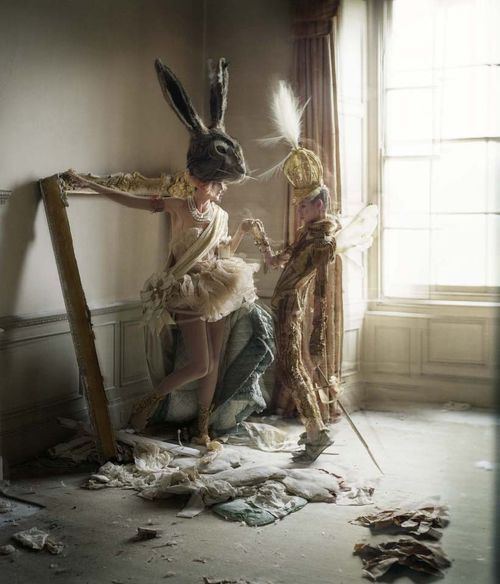
Denotation: The denotation of this image is that there are two subjects creating irregular shapes with their bodies. The lighting is deliberately overexposed and appears to have included minor HDR,  high dynamic range, adjustments. The composition is unusual in that the framing is not conforming to systems such as the rule of three grid or the fibonacci spiral but instead creates a jumpy image that the eye erratically follows due to the framing of the window, the subjects and the messied foreground.

Connotation: The connotation of this image could be the dream quality of life. The rabbit is a symbol of following the unusual path and could therefore in itself imply that people should create a world in which they are happy, much like Alice and the world of Wonderland, by following their own path whether it is relating to fashion or another contextual factor. The colourisation of the image being faded and light hues of colours could again reiterate the ideas of the dream world.

Context: This image was featured in Italian Vogue fashion magazine and is said to be a combination of Alice in Wonderland and aesthetic appeals of Marie Antoinette.


(Tim Burton/ Vogue)

Denotation: The explicit ideas of this image include composition; the rule of thirds is conformed to in this image in that the skeleton prop's arms are in line with the vertical lines whilst the head of the female model intersects the horizontal line in the grid. Furthermore, the colour red is again a recurring theme for Tim Walker; this may be due to this image featuring as part of a series in a magazine so the images have to work together in a cohesive nature.

Connotation: The flowers in the field behind are various types but marigolds are employed. Marigolds are used in certain cultures within festivals of the dead, for instance Dia De Los Muertos, to encourage and guide the spirits of the deceased to come back and visit at the altars during the celebrations due to their bright colours. The bold colours of the image also imply the vibrant nature of the festival through the sugar skull baked good gifted to others or the spirits, La Calavera Catrina known as the elegant skull figures and vibrant face paint and masks of calacas which is a colloquial term used for skulls in the festival. The elegant skull as part of the culture could also have been an inspiration for Tim Burton himself in his construction of the character "The Corpse Bride" who was an upper-class elegant woman with flowers in her hair as is often the modern representation of the figures in the culture and thus this could have influenced Tim Walker, working in cohesion with Tim Burton, to use the prop of a skeleton.

Context:  This image, much like the one previously mentioned, was featured in a magazine this one being Bazaar. This is part of the Tim Burton collaboration in preparation for a showcase of his work at the Museum of Modern Art. The image is entitled "Did you ever dance with the devil in the pale moonlight?". Other images in the series relate to Tim Burton's films "The Corpse Bride", "Edward Scissorhands" and "The Nightmare Before Christmas".

Research Log: Fashion Photographer Research: Margarita Kareva -

Fashion: Margarita Kareva - 

Why Chosen:

I chose the photographer Margarita Kareva due to her style of combining fashion and surreal locations. The colourisation and detail in the images are a strong inspiration and this is due to shooting in raw format. Kareva also adjusts her image with editing software post-production to achieve the final outcome and I would like to experiment more so with colour and filters on my own images.


Examples of Work:


Denotation: The compositional framing is within a square as is a genre convention used by Kareva. The layout still, however, conforms to the rule of three grid with the female subject at the intersection of the first vertical line. The colourisation of the image is lowly saturated and appears to have a filter which makes the image more fairytale-like. Additionally, the use of the blur in the foreground directs the viewers attention directly to the subject as opposed to the scene as a whole.

Connotation: The connotations of this image could be linked to the colours used. For instance, the white dress worn by the subject could imply a sense of purity and innocence as is used as the wedding colour in some cultures and, more aptly for this instance, is the wedding colour in Russia. Furthermore, the woodland setting with the butterflies could infer that the female within the image is actually a princess or fairy as is the story told by many of Kareva's pieces due to her inspiration from fairytales. White butterflies in some cultures are used to symbolise the souls of the passed and convey that angels are watching over someone. Although, the white butterflies, and butterflies as a whole, have been used as a technique of creating a surreal fairytale, ethereal or heavenly, environment for many years. For example, Winslow Homer, a painter, often placed butterflies in his work in illustration such as "The Butterfly Girl". His work could be seen to have had an inspiration on Kareva in the use of muted colours, costume and the setting of woodland. Moreover, the image could imply that the female herself is a woodland fairy as they are often depicted with butterfly wings.

Context: Kareva only started photography a few years ago and thus her portfolio is developing and evolving at a vast rate. Her work combines fashion lighting and locations with elements of surreal fantasy through editing, props and costumes. The models are transformed into fantasy creatures such as witches, royalty, fairies etc.


Denotation: The denotation of this image is again that the framing is within a square ratio with the use of colour being emphasised by editing software. The lowly saturated backdrop juxtaposed to the highly saturated colours in the foreground add depth to the image. The technique of blurring is employed once more, an almost bokeh style, in the top right third of the compositional grid. The subject is making direct eye co tact with the audience which adds to the atmosphere and make the viewer feel as though they are also in the scene. Additionally, the snow marks are added post-production and add another element to the fairytale style.

Connotation: The image could depict a woman who is a free spirit and travels the landscape gathering goods although the clothing and goods she carries imply a sense of wealth. The image could also draw on the idea of the story of "Anastasia" in which the royal Romanov heir is hexed and goes missing in the woods after escaping the palace.

Context: Kareva is a Russian based artist but often travels the world and photographs various cultural forms of dress to create surreal fashion images. The above image includes traditional cultural dress.


Denotation: The denotation of this image is within a square ratio much like the others mentioned above. Also, the compositional rule of three grid is again adhered to in that the two foreground wolves are on two vertical cross-sections whilst the subject is framed in the central column. Also, the muted colours again make an appearance alongside the added emphasised snow made in post-production editing.

Connotation: The implied character of this image is like a bride who has experienced sorrow in some manner such as being left at the alter like Miss Havisham from "Great Expectations" or one who was betrayed like Tim Burton's "The Corpse Bride"; this is conveyed through the veil worn over the face with the garland of flowers on the head of the subject. However, the subject could also represent a character such as a woodland witch living with her companions of wolves. The colour white in fairytales is often used to symbolise who the good characters are and thus it could be inferred that the above character is a good witch. Furthermore, the symbolism of wolves in Russian culture links to that of the Chechen nation. The symbol of the wolf in this nation, known as the Chechen grey wolf, is that in a poetic sense it links to being as "free and equal like wolves" but also as a sign of "courage and tenacity".  There is myth that the founder of the Chechen nation was raised by a female wolf hence the modern understanding of the phrase "raised by the she-wolf" as a compliment of someones admirable traits. The position of the wolf in illustration relating to this symbolism have variant meanings: the howling wolf symbolises patriotism, the resting wolf is a reference to the wolf mother whilst a direct address of the viewer is intended to evoke a string sense of emotion. As a result, the female in the image could be a reference to the Russian hero who was said to have been raised by wolves which is reinforced by the one wolf laying down in the bottom left third of the grid.
  Context: Kareva herself has said that her work stems from fairytales and that some characters in her pieces are based off of established characters although some are pure imagination and as is voiced above this character could be inspired by the idea of "The Corpse Bride" as a character or concept and that of Miss Havisham from "Great Expectations" although the character could be a fictional witch or fairy-like character. They are, however, all inspired by fantasy novels. Kareva often uses varied props and costumes and is known for using trained real animals in her photoshoots to create surreal images.


Denotation: This image, unlike the above others, is more highly saturated. The composition is however alike the others in the square ratio framing. Depth of field is employed to make the model in the foreground the central focus of the image. There is no blur used in this instance and instead the detail on the image is exaggerated by the increased colourisation.

Connotation: The colours used in the image are highly vibrant and the colour blue appears highly significant. In western culture the colour blue is associated with sorrow and sadness which could link to the composition of the model and the eyeline path. Furthermore, the colour blue is continued in the animals featured in the image. The blue morpho butterfly is often interpreted in different ways internationally. In many cultures the butterfly, regardless of colour, is associated with the souls and spirits of the deceased. Although, other interpretations of butterflies include ideas of rebirth due to their life cycle, calming due to the colour but also  as that of a wish granter. Furthermore, the butterfly is often associated with females due to their delicate feminine nature. The contrast between the vibrant blue of the butterflies as opposed to the red of the hair could simply be for aesthetic appeal but also to create oppositions in the piece. The position of the model is very protective in that the hands are covering the area of the body in which the most vital organs are kept and thus it is considered a defensive position. This image again implies ideas of a constructed fairytale like character but also seems to have dark undertones.

Context: The models are transformed into fantasy creatures such as witches, royalty, fairies etc.

Tuesday, 8 November 2016

Research Log: Fashion Photographer Research: Ernesto Artillo -

Fashion: Ernest Artillo - 

Why Chosen:

I chose the photographer Ernesto Artillo as his photographic art combines elements of fashion with surrealism and ideas that I wish to incorporate into my own work in the future; such ideas include use of colour, physical manipulation and collage techniques. His work reminds me of a previous surrealist artist that I have studied previously named Matthieu Bourel. The possible connotations of these works appear to relate to criticisms of ideas such as beauty ideals and standards but also comment on celebrity culture and loss of individual identity through mass media socialisation.


Examples of Work:


Denotation: This image is of the collage technique with various components combined on one background image of a portrait. The photographer has added highly saturated colour segments as the final layer of the image to juxtapose directly to the black and white filter on the other images.

Connotation: This final outcome conveys ideas of artistic and photographic influences throughout time and their relevance today. The final layer is in the style of Picasso and is formed in a way that appears to celebrate the origins of the artistic community rather than criticise it. Additionally, the central diagonal divide of the portrait beneath the Picasso-like drawing could infer a class difference between the masses. The left compositional side of the photograph infers a higher class status through the groomed appearance and fur collar whilst the right third of the grid combines a less groomed appearance with a simply striped scarf often associated with the football community and the lower working classes. The black and white filter element of the piece appears very intentional for the photographer does not usually employ the shades. It appears to imply, in a celebratory tone, the development of photography throughout time with the polaroid style compositional framing also reiterates this.

Context: This is part of the 'Izzue' artwork section and is a commissioned piece for the Hong Kong fashion company.


Denotation: This is another example of collage work as it is a favoured style by the the photographer although they do also explore through the medium of paint. The colours used vary in that one image is black and white whilst the other is in colour, all be it muted and lowly saturated colours. The style is portraiture and landscape with the two just posing one another directly. The subject of the portrait is a famous celebrity of the modern era.

Connotation: The implications of this work appear to be the study and deconstruction of societal ideologies such as celebrity culture. The use of a famous face in portraiture is usually to endorse a product or lifestyle of some kind but this image is challenging that. The removal of the face from the main body to reveal an underneath world suggests the idea that anonymity is a feature within all people. We are all of the same structures underneath: hopes, dreams and memories etc.

Context: The image features the celebrity Daniel Radcliffe.
http://www.lamondamagazine.com/en/m/celebration/ernesto-artillo/


Denotation: This image is a combination of collage techniques and the medium of paint. The portrait appears to be shot using high key lighting before being edited beneath a black and white filter which contrasts to the saturated images and colours used. The face of the subject is removed or covered by the section of black and suggests anonymity which immediately draws audience attention.

Connotation: This image could implicitly convey the beauty standards of society and how it is a toxic environment for so many. For instance, the anonymous subject could be a representative of all humanity, specifically young women, and how standards make them feel. The lurid colours appear to infer the bright world of fashion and beauty but are also in a formation that looks like camouflage print and could therefore support the idea that mass media influenced youth is a battleground. The flower being grasped tightly by the subject could infer the possibility of growth if the environment becomes less poisonous.

Context: N/A.


Denotation: This image is a photograph of a sculpture created by photographs and is such an inception-like surrealist final outcome. The images are all fashion shots from the Hong Kong company Izzue alongside landscape photographs. The images combine to form a cityscape.

Connotation: This image appears to infer the idea of fashion as a pinnacle of society with the subjects being like buildings and establishments in themselves. It also conveys fashion's place in society which is often in the centre of cities.

Context: This is a paper sculpture created for 'Izzue' in Hong Kong and is part of Artillo's commissioned fashion photography rather than personal.